

Ward 3 residents overwhelmingly approve of public policy changes that would enable sensible “gentle density” of housing stock upgrades in their neighborhoods. That’s the clear takeaway from “Plenty of Room at the Inn,” the 2024 Master’s thesis from Virginia Commonwealth University’s Harrison (Mac) Hyde.
What is “gentle density?”
Gentle density is a term to describe multi-family housing at a low density residential scale. It could include a house with a basement apartment, a backyard cottage, a duplex, triplex, fourplex, townhomes, small garden apartments, and other house-scale residence types. It is a way to provide slightly more housing than can be provided in areas that only allow single-family homes. While typically not capital “A” affordable housing, these types of residences are priced less than single family homes. The land cost is shared and the individual residences tend to be smaller than a single family home. A great example of gentle density is Porter St in Cleveland Park between Connecticut Ave and 34th St. There you find a mix of single family homes, semi-detached and row homes, and house-scale apartment buildings. We believe that every street in DC should be able to have the housing options that Porter St. provides.
A Local Trend
The move to gentle density, and away from reserving vast areas of residential land exclusively for only the largest and most expensive form of housing, is a trend that is picking up speed around the country and right here in the DMV. Last year, Arlington County changed its land use rules to allow anything from a single family home up to a fourplex anywhere in the County. This year, the City of Alexandria followed suit in its “Zoning for Housing/Housing for All” legislation, also allowing fourplexes city-wide. This past month, the Montgomery County Planning Board recommended changes to low density residential zoning to make them more diverse. It will be considered by the County Council later this fall.
Buyers Seeking Lower Prices Elsewhere
In giving its approval to the rule changes, the MoCo Planning Board said, “The time has come for Montgomery County to break free from outdated zoning that has constrained the housing supply, led to skyrocketing real estate prices, and has forced more of the county’s middle-income population to search elsewhere for housing”1. That same dynamic is happening here in DC’s Ward 3. The vast majority (77%) of residential land in the Rock Creek West Planning Area is occupied by single-family detached homes, but it accounts for only 29% of the area’s households2. With skyrocketing home prices – the average single-family home in the area is about $1.4m according to Zillow, first time home-buyers are seeking out lower-priced DC neighborhoods like Petworth, where the average single family home price, $716,000, is less than half of what it is in Rock Creek West. Lower cost neighborhoods like Petworth have seen its Black population drop significantly as higher income white residents move into the existing housing stock.
The key question that is surely on the minds of many residents living in Rock Creek West’s single-family-only neighborhoods: can land use regulations be changed in a way that does not fundamentally alter the low density residential nature of these neighborhoods while also providing significantly more housing opportunities attainable to more households?
Mac Hyde’s Plan
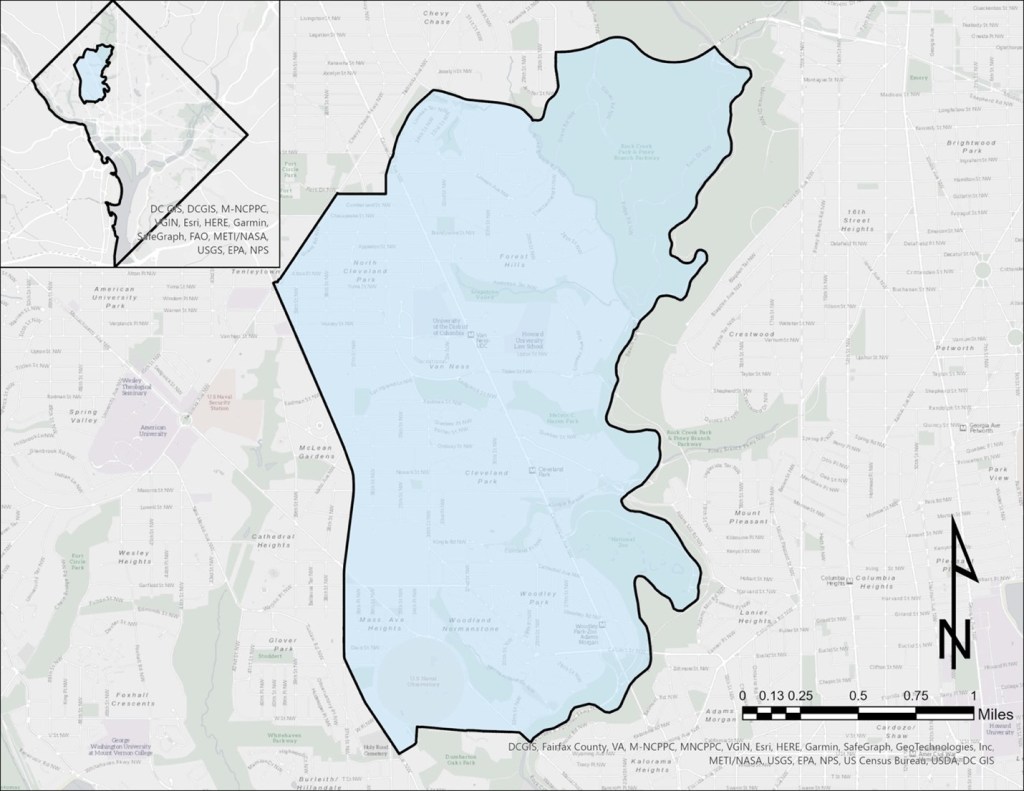
Hyde, a former resident of Cleveland Park, who earned his postgraduate degree in City/Urban, Community and Regional Planning in 2024, focused his work on the past, present, and future of housing policy in several Ward 3 neighborhoods along the Connecticut Avenue corridor (see the mapped study area below).

A key component of Hyde’s findings came from a comprehensive online survey that asked residents about their attitudes toward different forms of housing. Over three hundred individuals who live within the study area boundaries responded.
Respondents were presented with text and photos describing four types of gentle density: small multi-family buildings, residential flats, duplexes, and accessory dwelling units (or ADUs)3. They were asked which gentle density housing type(s) they preferred and, of the types selected, whether they’d support legislative and/or zoning changes to allow those types to be built in their neighborhood. Eighty-four and a half percent of respondents answered “yes” to the latter question.

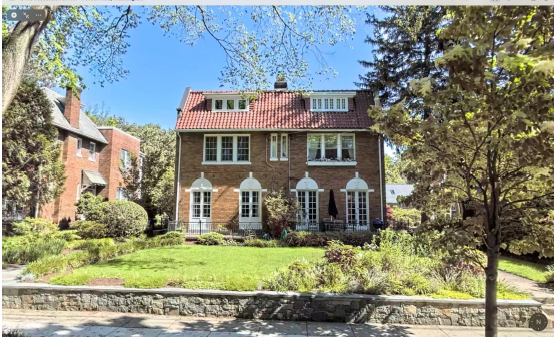
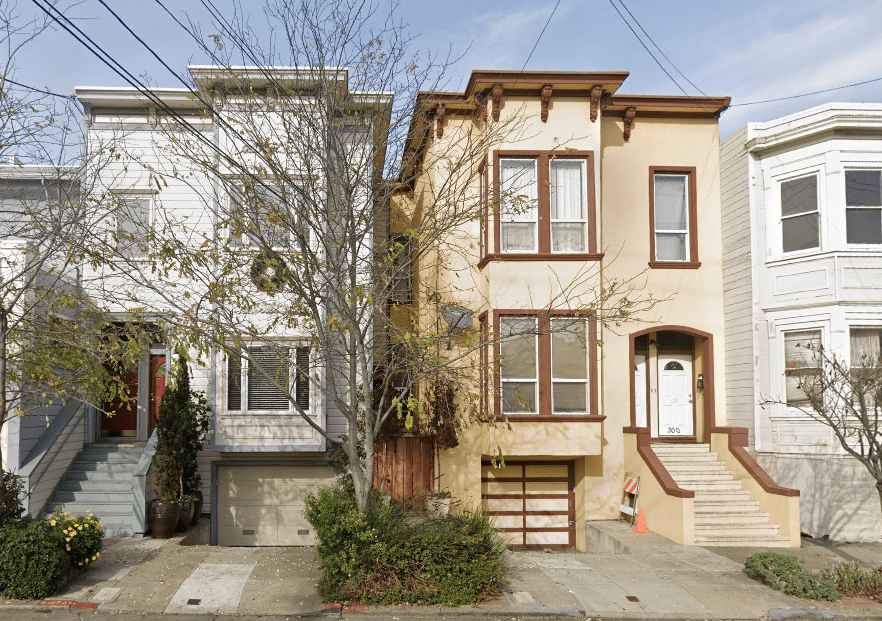
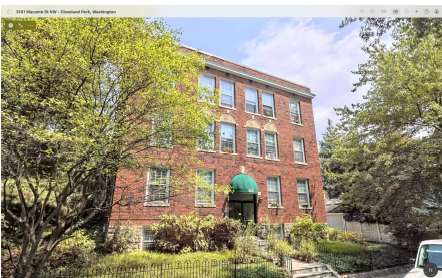
The survey also dismantled the fallacy that homeowners and single-family residents are predisposed to oppose gentle density. The 320-person response pool was substantially over-weighted toward both groups, yet still produced the robust pro-gentle-density results4.
The analytical portion of Hyde’s thesis underscored what residents of his study area have long known: we have plenty of room and plenty of methods to enact sensible gentle density measures that still preserve the neighborhoods’ charm and character. Sensible is the key word in that sentence. As Hyde wrote, “no skyscrapers was a common [respondent] refrain.” We couldn’t agree more. No one moves to Ward 3 to recreate Manhattan, New York, but that doesn’t mean we should have a housing policy more fit for Manhattan, Kansas. We live in a diverse, vibrant city, and the housing stock in Cleveland Park and other adjacent neighborhoods should reflect that.
Hyde’s policy recommendations are in keeping with that sensibility mindset. His first recommendation would amend the District’s zoning code to recategorize the study area’s lowest-density zoning categories to RA-1, which is the least-dense zoning option that allows for low-rise apartments. His second set of recommendations would allow for ADU construction on properties abutting alleys and remove parking minimums for existing and newly developed units. Additional recommendations include the establishment of design standards for use in historic districts, the preservation of green spaces and trees on commercial strips, and the reduction of permitting requirements for certain types of accessory construction.
DC’s Comprehensive Plan
As DC’s neighbors move forward to enact land use changes, no similar action is being considered in D.C. In 2019, at the request of Ward 1 Councilmember Brianne Nadeau, the Office of Planning issued a report on single family zoning. It makes a solid case for expanding housing choice, “in single-family zones in a targeted manner that prioritizes neighborhoods that are high-opportunity, high-cost, or near high-capacity transit.” However, the report falls short of advocating immediate action. It concludes that a future rewrite of the Comprehensive Plan is needed to allow more than single family detached and semi-detached homes in areas designated by the Future Land Use Map as “low density residential.” We disagree. The Comprehensive Plan uses RA-2 as an example zone for “moderate density residential,” the next step up from “low.” RA-2 allows for apartment buildings significantly larger than the scale of a single family home, with heights of 50’ and greater lot coverage. Mac Hyde’s recommended zone, RA-1, allows for building dimensions the same size, or in some cases, smaller than single family zones. The D.C. zoning Handbook, under RA-1, states, “The RA-1 zone provides for areas predominantly developed with low- to moderate-density development, including detached dwellings, rowhouses, and low-rise apartments.”
In the Rock Creek West Element within the Comprehensive Plan, policy RCW-1.1.1 notes that we should “preserve the low-density residential neighborhoods west of Rock Creek Park. Future development in both residential and commercial areas should be carefully managed to address the existing scale, function, and character of these neighborhoods. Updates to zoning regulations offer the opportunity to create more accessory dwelling units for this area to help absorb a share of the District’s growth and provide a more proportional portion of affordable and moderate-income housing sensitive to existing neighborhood context. 2308.2” While we are all for revisiting this language in a future rewrite of the Plan, what is recommended in the Mac Hyde report, we believe, is entirely consistent with this policy.
We support Hyde’s recommendations exactly as he originally wrote them, which call for converting single-family-only zones in the planning area to the RA-1 zone. That said, we are also open to developing custom zoning for this area.
We strongly encourage the local Advisory Neighborhood Commissions, the D.C. Office of Planning, and the D.C. Zoning Commission to consider Hyde’s recommendations and begin a process to use this high-opportunity area of Washington, D.C. as pilot for land use reform now. The housing crisis is not limited to the lowest income households, although it is most acute among them. Renters aspiring to own, first time home buyers, young and growing families, empty nesters looking to downsize all can benefit from more low-density housing choices in this planning area. Mac Hyde has demonstrated that area residents have an open mind and are ready for the next steps. In addition to being what people want, gentle density is the right decision from an economic, environmental, and equity lens. Like our area neighbors, the time to act is now.
Please see Mac Hyde’s submitted final report on the VCU website:
Plenty of Room at the Inn: Strategies for Gentle Densification of Cleveland Park, Woodley Park, Van Ness, and Forest Hills, DC
Archives: Gentle Density Planning Study
Hello! I am Mac Hyde, a former Cleveland Park resident currently seeking my Masters of Urban and Regional Planning at Virginia Commonwealth University (VCU). As part of my degree I am conducting a study, in partnership with Cleveland Park Smart Growth, which is examining the possibility of increasing the supply of housing in the Cleveland Park, Woodley Park, Van Ness, and Forest Hills neighborhoods. This area is largely between Wisconsin Avenue to the west and Rock Creek Park to the east and south, and Nebraska Ave/Broad Branch Road to the north. These neighborhoods were chosen due to their proximity to a Metro station (being within a ½ mile) and having predominantly single-family zoning. This project is not affiliated with the District Office of Planning and the recommendations made are not official positions of the city.
Live in the Study Area? Take our Housing Survey! (closes Feb 24)
Interested in learning more? Read my Masters Capstone Proposal “Plenty of Room in the Inn”
The goal of the study is to determine how additional housing can be incorporated into areas currently zoned for only single family homes in a way that has minimal impact to the existing neighborhoods. “Gentle Density” is a term that refers to housing types that can accommodate more than one household on a property that is sized for a single family home. These low-density housing types could include accessory dwelling units (ADUs) such as basement apartments, backyard cottages, and apartments over garages; townhouses; duplexes, triplexes, fourplexes; residential flats that accommodate multiple units (usually 2 or 3) in a single building; and small apartment buildings of three or fewer floors.
If you live within the study area, we hope you will take this short survey and participate in future events.
The first of two design workshops was held on February 21st at the Cleveland Park Library. The next design workshop will be held at the library on Saturday, February 24th from 1:15 to 3:15pm.
Interested in learning more? Read my Masters Capstone Project Proposal, “Plenty of Room in the Inn.“
Questions or comments? Please email me at hydehm@vcu.edu.
- https://montgomeryplanningboard.org/montgomery-county-planning-board-recommends-changes-to-single-family-zoning-in-montgomery-county/ ↩︎
- Rock Creek West Area Element, pp 23-5 – 23-7, https://planning.dc.gov/sites/default/files/dc/sites/op/publication/attachments/23_RCW.pdf ↩︎
- Hyde defines as “the practice of building accessory dwelling units (ADUs), residential flats (single family structures that have been internally divided into individual units), duplexes, and small multi-family buildings (no taller than four stories) in areas which have historically been exclusively single-family homes.” ↩︎
- Of the 320 respondents, 66.92 percent were homeowners, compared with 42.86 percent of the overall study area, per the U.S. Census Bureau’s American Community Survey. Additionally, 22.56 percent of respondents lived in detached single-family homes and 14.29 percent in attached single-family homes, compared to 15.65 and 8.78 percent, respectively, in the overall study area. ↩︎
 Cleveland Park Smart Growth